The Bio Page Content Audit: What to Keep, Move, or Remove
A bio page audit is the difference between a cluttered link list and a high-converting destination. Learn the Keep, Move, or Remove framework to streamline your information design.

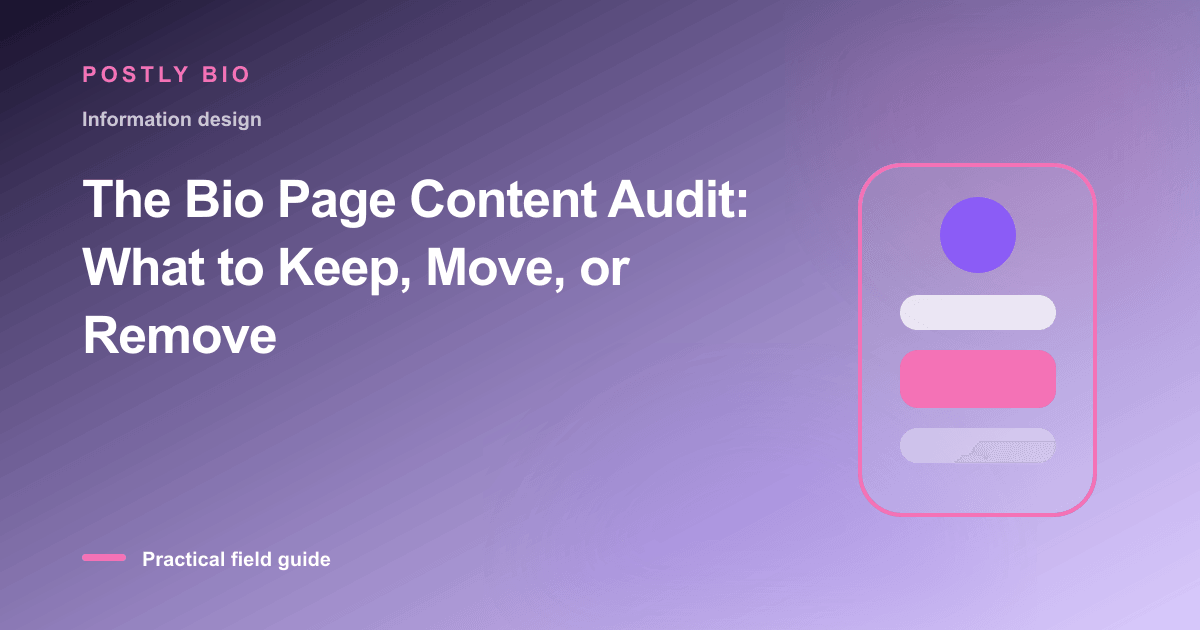
The primary goal of a bio page is to reduce the distance between a visitor's curiosity and your most valuable outcome. Over time, however, these pages suffer from content creep—the gradual accumulation of temporary links, outdated promotions, and redundant social icons. A content audit is not just a cleaning exercise; it is a strategic realignment of your information hierarchy. To conduct an effective audit, you must categorize every element on your page into one of three buckets: Keep, Move, or Remove.
The Keep Bucket: High-Intent and High-Velocity
Items in the Keep bucket are the non-negotiables. These are the links and media blocks that directly support your current primary objective. Typically, these are high-velocity items—those that receive the most clicks—or high-intent items that lead directly to revenue, lead generation, or core audience growth. When deciding what belongs at the top of your bio page, prioritize your Primary Active Goal. If you are a consultant, this is your booking link. If you are a creator, it might be your latest video or newsletter signup. These items should remain prominent, often utilizing media-rich blocks to stand out from standard text links. A Keep item must pass the utility test: if this were the only link on the page, would your business still function? If the answer is yes, it stays.
The Move Bucket: Secondary Value and Contextual Depth
The Move bucket is for content that is still valuable but is currently creating friction by occupying prime real estate without the conversion data to justify the position. Moving content usually involves two actions: demotion or consolidation. Demotion involves shifting a link further down the page. This is ideal for evergreen resources, About sections, or secondary offerings. Consolidation involves grouping related items. For instance, instead of listing four separate social media profiles as full-width buttons, move them to a dedicated social icon row. This preserves the connection point without diluting the visual focus of your primary call-to-action. Understanding bio page information hierarchy is essential here; the goal is to create a logical flow where the most urgent items are seen first, followed by supporting context. Using media-rich blocks for your Keep items while using simple text links for your Move items creates a visual hierarchy that guides the eye naturally.
The Remove Bucket: Friction and Obsolescence
The Remove bucket is often the hardest for creators to fill, yet it is the most impactful for conversion. Every link you provide is a tax on the visitor’s attention. If a link has low engagement or refers to a past event, it is likely causing decision paralysis. Common candidates for removal include outdated event registrations, seasonal promotions from previous months, and secondary social platforms where you are no longer active. When considering how many links a bio page should have, the answer is usually fewer than you think. If an item hasn't been clicked in 30 days and isn't a core part of your brand identity, it is noise. Removing these items reduces the cognitive load on your visitors, making them more likely to click the links that actually matter.
The Audit Decision Table
Use the following table to quickly categorize your current bio page content based on performance and intent.
| Content Type | Performance Metric | Audit Action |
|---|---|---|
| Primary CTA (e.g., Bookings) | High Clicks / High Intent | Keep at Top |
| Social Media Profiles | Medium Clicks / Low Intent | Move to Icons |
| Past Event / Promo | Zero Clicks / Expired | Remove |
| Secondary Services | Low Clicks / High Intent | Move to Middle |
| General 'About' Info | Low Clicks / Low Intent | Move to Bottom |
Worked Example: The Independent Consultant
Consider a consultant who hasn't updated their bio page in six months. Their page currently lists twelve items, including a newsletter signup, a booking link, three different service packages, four separate social media buttons, two blog posts from last year, and a link to a charity drive that ended in December. The audit process transforms this cluttered list into a focused destination. The newsletter and booking link are kept at the top. The social media buttons are consolidated into a single row of icons. The service packages are moved into a single media block or a dedicated section further down. The old blog posts and the expired charity link are removed entirely. The result is a page that loads faster, looks cleaner, and directs 100% of the attention to the consultant's current business goals.
Failure Modes to Avoid
One of the most common failure modes is the Archive Trap—treating the bio page as a resume or a portfolio of everything you have ever done. A bio page is a landing page, not an archive. Another failure mode is ignoring the data. If you are using a tool like Postly Bio, you have access to click tracking and analytics. Use these metrics to validate your Keep list. If your primary link isn't getting clicks, it might not be the link's fault; it might be the surrounding clutter. Finally, avoid the Just In Case mentality. Many creators keep links just in case someone wants to find an old project. If they really want to find it, they will look at your full website or search for it. Your bio page should be optimized for the 90% of users who are looking for what you do right now.
The Technical Audit
Beyond content, a technical audit is necessary. Ensure all links use HTTPS and that no destinations lead to 404 errors. Check your page on both iOS and Android devices to ensure the hierarchy translates well to smaller screens. Postly Bio pages are designed for secure delivery and mobile responsiveness, but the content you place within them must still be curated for the mobile experience. A link that looks fine on a desktop might take up half the screen on a phone, further emphasizing the need for consolidation and removal.
Conclusion
A successful content audit should be performed every 30 to 60 days. Start by reviewing your analytics to see where the drop-off occurs. Use features like smart ranking to see which items naturally gravitate toward user interest, but don't be afraid to manually override the hierarchy to support a new campaign. By maintaining a focused destination, you ensure that every visitor knows exactly what you want them to do next. Build a focused Bio Page with PostlyBio to put these principles into practice and transform your link list into a conversion engine.
Follow via RSS: latest articles · full article archive